Prompt Injection Risks in Compliance AI Systems
Compliance AI systems are uniquely vulnerable to prompt injection attacks.
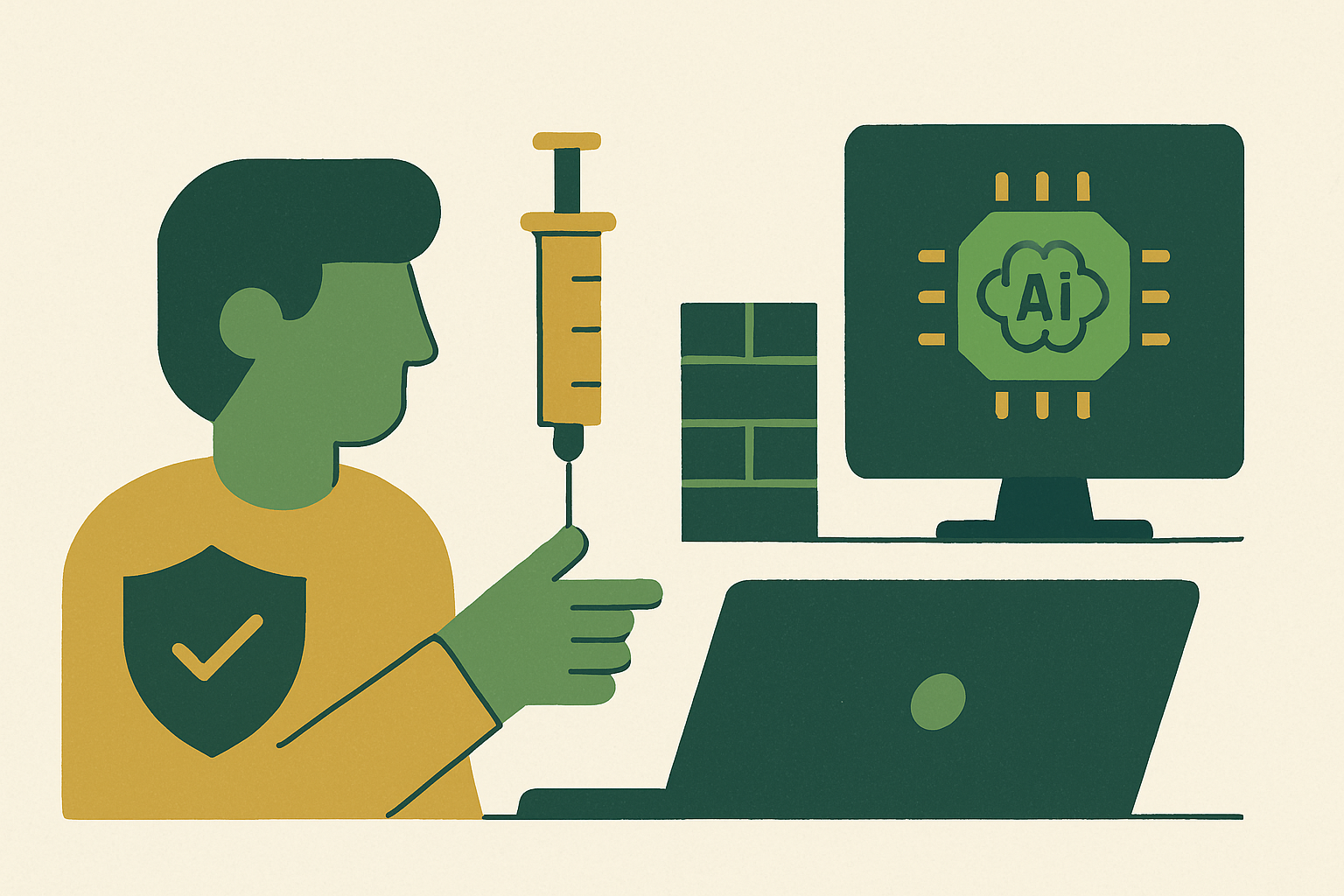
Compliance AI systems now sit at the exact intersection where prompt injection does the most damage: they read documents nobody trusted in the first place, they hold permissions across multiple internal systems, and their output becomes the audit trail a regulator later inspects. That combination is the design brief for how these systems get built. It is the design brief. A KYC review agent, an AML transaction monitor, a sanctions-screening tool: each one exists specifically to take in files, forms, and reports from outside the organization and turn them into a decision that carries legal weight. Without the untrusted-document intake, there is no product left to sell.
Compare that to a coding assistant that reads internal repositories the engineering team already wrote and already trusts. A compliance agent does the opposite by design: it reads the outside world, on purpose, because that is the whole job. Add to this the fact that financial services firms increasingly run these systems in pipelines, customer service agents handing off to risk assessment agents, which hand off to compliance agents, which hand off to fraud detection agents, and the exposure compounds at every handoff rather than staying contained at the point of entry.
Prompt injection and its architectural fix
Security guidance from OWASP, Sysdig, and Vectra each describes prompt injection as an attack that gets a large language model or an AI agent to carry out an attacker's instructions instead of the system's own. The phrasing varies slightly across sources, but the mechanism they describe is identical.
The reason it persists is structural, rooted in how the architecture itself handles input. It's structural. A large language model takes in the system prompt, the user's input, and any retrieved documents as one continuous stream of tokens. Nothing in that stream is tagged as "trusted instruction" versus "untrusted data" at the model layer, because the architecture was never built to make that distinction.
The SQL injection comparison gets used a lot, and it's useful up to a point. SQL injection got solved by parameterized queries, a structural wall between code and data that keeps an attacker's string from ever executing as a command. Prompt injection has no equivalent wall. There is no parameterized query for natural language, because the model's whole value comes from processing language flexibly rather than through a rigid, separated channel.
Three variants matter here. Direct injection shows up in the user's own turn, plain to see, and is the easiest for input filters to catch, especially in compliance systems that already have access controls in front of the chat window. Indirect injection is the harder problem: the malicious instruction sits inside a document, an email, or a third-party report that the agent retrieves on its own, while the user's actual question stays completely benign. The filter watching the user's input never sees the attack at all, because the attack didn't come through that door. OWASP's guidance on agentic applications treats this pattern, delivered through documents, emails, and web pages, as the leading threat facing agentic systems. Stored injection is the slow-burn version: instructions planted inside long-term memory, an indexed knowledge base, or a RAG corpus, sitting dormant until some later session, possibly touching a different user entirely, triggers them.
Named incidents and CVEs from 2025–2026
Security audits of production AI deployments have found prompt injection present in 73% of the systems assessed. Security audits of production AI deployments have found prompt injection present in 73% of the systems assessed, meaning this isn't a rare edge case discovered in a lab, but a condition found in nearly three out of every four real deployments checked.
EchoLeak is the incident that made the risk concrete. Disclosed by researchers at Aim Labs, it targeted Microsoft 365 Copilot and stands as the first documented zero-click data exfiltration carried out through prompt injection in a production AI system. An attacker sent an ordinary email. The target never opened it. Copilot processed the message in the background as part of its normal indexing behavior, and a later, completely unrelated query from the user triggered the data leak. No click, no attachment opened, no user error anywhere in the chain. The vulnerability carried a CVSS score of 9.3, and what made it alarming wasn't the score so much as the mechanism: the attack surface was the agent's own habit of reading things autonomously, a feature, not a misconfiguration.
Other cases followed the same pattern of high severity paired with active exploitation. A critical vulnerability hit GitHub Copilot at a CVSS of 9.6. A separate vulnerability in the Cursor IDE scored 9.8. Both carried critical severity scores reflecting real exposure in deployed systems. A further vulnerability, CVE-2025-59532, surfaced against OpenAI's Codex CLI, where the agent's own generated output ended up redefining the boundary of its sandbox, essentially letting the model talk its way out of the container it was supposed to stay inside.
How the three defining features of compliance AI compound the blast radius
Three things make compliance AI a harder target to defend than the average enterprise chatbot, and each one takes a generic prompt injection risk and makes it specifically worse for this domain.
The first is the ingestion of untrusted documents as the actual core function. KYC files, AML transaction records, sanctions screening data, customer-uploaded forms: these are exactly the input types the FINOS framework names as injection vectors, emails and third-party market reports included. And the pipelines carrying them increasingly run on RAG and agentic architectures, with 53% of companies now relying on that setup. The trouble is that most RAG systems treat everything they retrieve as equally trustworthy, with no isolation between the external document and the system's own instructions. A documented breach of an enterprise RAG system showed exactly this failure mode, and the structure of a compliance RAG pipeline is not meaningfully different. The risks specific to retrieval-augmented architectures have been recognized across leading security frameworks as warranting dedicated controls.
The second feature is elevated permissions and cross-system authority. Prompt injection doesn't need to break authentication to cause damage: it can bypass role-based access controls, trigger API calls the user never authorized, and reach sensitive data indirectly, all while every login credential stays perfectly valid. The blast radius scales with whatever the agent is connected to. An agent wired into multiple enterprise systems doesn't expose one person's account when it's compromised; it exposes the sum of every permission it was ever granted, a distinction made plain in published security analysis of agentic AI deployments. AI agents also move far more data than a human user does in comparable workflows, one estimate puts the multiple at around sixteen times. This means a compromised compliance agent isn't a single-account incident but a high-volume exposure event by default. Multi-agent compliance setups, risk agents feeding fraud agents feeding AML agents, mean one successful injection at the front of the pipeline can hijack the goal of every agent downstream of it.
The third feature is that the output itself carries regulatory weight. A financial advisory chatbot that gets jailbroken into recommending something that skips a suitability check, or into fabricating a transaction history, hasn't produced an awkward or embarrassing reply. It has produced a potential regulatory violation with the firm's name on it. Transaction monitoring AI making live calls about suspicious activity, if subverted, doesn't just return a wrong answer somewhere in a log file: it generates a false negative that can end up satisfying a regulator's audit trail while quietly missing the thing the audit trail was supposed to catch. The same model that got injected is the one producing the compliance artifact that gets reviewed later, and that is the deeper structural problem underlying all of this. Nothing independently checks that artifact unless someone deliberately built a separate verification layer to do it.
Current attack success rates and their meaning for compliance teams planning deployments
Attack success rates run from 50% to 84%, depending on system configuration and how many attempts the attacker gets. Research across multiple studies found rates between 66.9% and 84.1% specifically in agent systems that have auto-execution capabilities turned on.
An 84% success rate in an agentic system is a risk to be contained, detected, and recovered from, not one a compliance team can plan around avoiding. It's a risk to be contained, detected, and recovered from, because avoidance isn't on the table as an option.
Anthropic's system card for Claude Opus 4.5 shows concretely how these attack rates scale. In agentic coding environments, indirect prompt-injection attacks against the "thinking" variant succeeded 4.7% of the time at a single attempt, 33.6% of the time at ten attempts, and 63.0% of the time at one hundred attempts. That's a frontier model, built with the best defenses currently available, and the numbers still climb steadily with repetition. Persistence beats sophistication, which is not a comforting thing for a compliance team to learn but is the thing NIST research backs up as well: novel agent attacks hit an 81% task-hijacking success rate against known attack baselines that are just 11%. Most enterprise defenses were built and calibrated against that 11% baseline. They target a completely different threat.
Regulatory and framework requirements for compliance AI on prompt injection
Prompt injection now maps onto at least seven major frameworks, including OWASP, MITRE ATLAS, NIST, the EU AI Act, ISO 42001, GDPR, and NIS2. That spread alone signals that no single regulator or standards body treats this as a niche technical concern anymore.
NIST AI 100-2 E2025 addresses prompt injection as a class of attack in which untrusted input causes behavior the system was never designed to permit. The edition expanded well past its 2023 predecessor to cover autonomous agent vulnerabilities, including indirect injection and supply-chain attacks aimed at the tools an agent calls. NIST is also direct about the limits of what's currently possible, stating that existing mitigations cannot offer fool-proof prevention. Companion NIST guidance tells organizations deploying AI agents to integrate prompt injection defense into their evaluation and risk management controls. The guidance is voluntary, but it's fast becoming the de facto floor under the generative AI profile regardless.
The EU AI Act's timeline moved. The AI Omnibus, enacted July 27, 2026, pushed the full high-risk system obligations under Annex III back to December 2027. Industry counsel have pointed to interoperability between systems as a governance headache firms are already wrestling with as they invest in AI that may eventually land in a high-risk category, since governance has to bridge technical oversight with the compliance frameworks that already exist. Others at the same event made a related point: the AI Act can't be read in isolation, because firms have to weigh how it interacts with their existing regulatory obligations. The broader digital omnibus initiative has also delayed the Annex I requirements, covering AI embedded in already-regulated products, to August 2028, which leaves a fair number of firms in limbo about exact timing. None of that delay makes the underlying security exposure any smaller. It only pushes back the date by which a firm has to prove it dealt with it. Other frameworks, including ISO 42001 and the NIST AI RMF, address AI security controls in ways that apply independent of whatever the EU's calendar ends up looking like.
Layered defense as the only viable architecture
Adaptive attacks get past essentially every published defense when that defense stands alone, and this holds true even for frontier models out of OpenAI, Google, and Anthropic after their best available protections have been applied. No single filter, no single prompt-hardening trick, closes this gap on its own.
The economics of the problem explain why. An attacker needs exactly one instruction to work. A defender has to block every malicious instruction across every input the agent might ever touch, emails, uploaded documents, web pages, internal wikis, even the output of some other agent earlier in the pipeline. That's an asymmetry no single control can resolve, because the defender is playing a much bigger board than the attacker is.
Practitioners and formal guidance converge on roughly the same three-part structure instead. The first layer is architectural prevention: least-privilege permissions so an agent only holds the access it strictly needs, sandboxing of inputs and outputs, and isolation of external data from system instructions built directly into the pipeline, so retrieved content is treated as untrusted by default rather than by exception. The second layer is runtime detection, behavioral monitoring that watches what an agent actually does rather than trusting what it was configured to do. That distinction is what the January 2025 RAG breach exposed: the defenders had reviewed their configuration assumptions carefully, but nobody was watching the agent's observed behavior in real time, and the gap between the two is where the breach lived. The third layer is governance: human review sitting at the consequential decision points, and clear accountability assigned for whatever an agent does, so that when a compliance artifact turns out to be wrong, there is a person and a process responsible for catching it before it reaches a regulator's desk.